

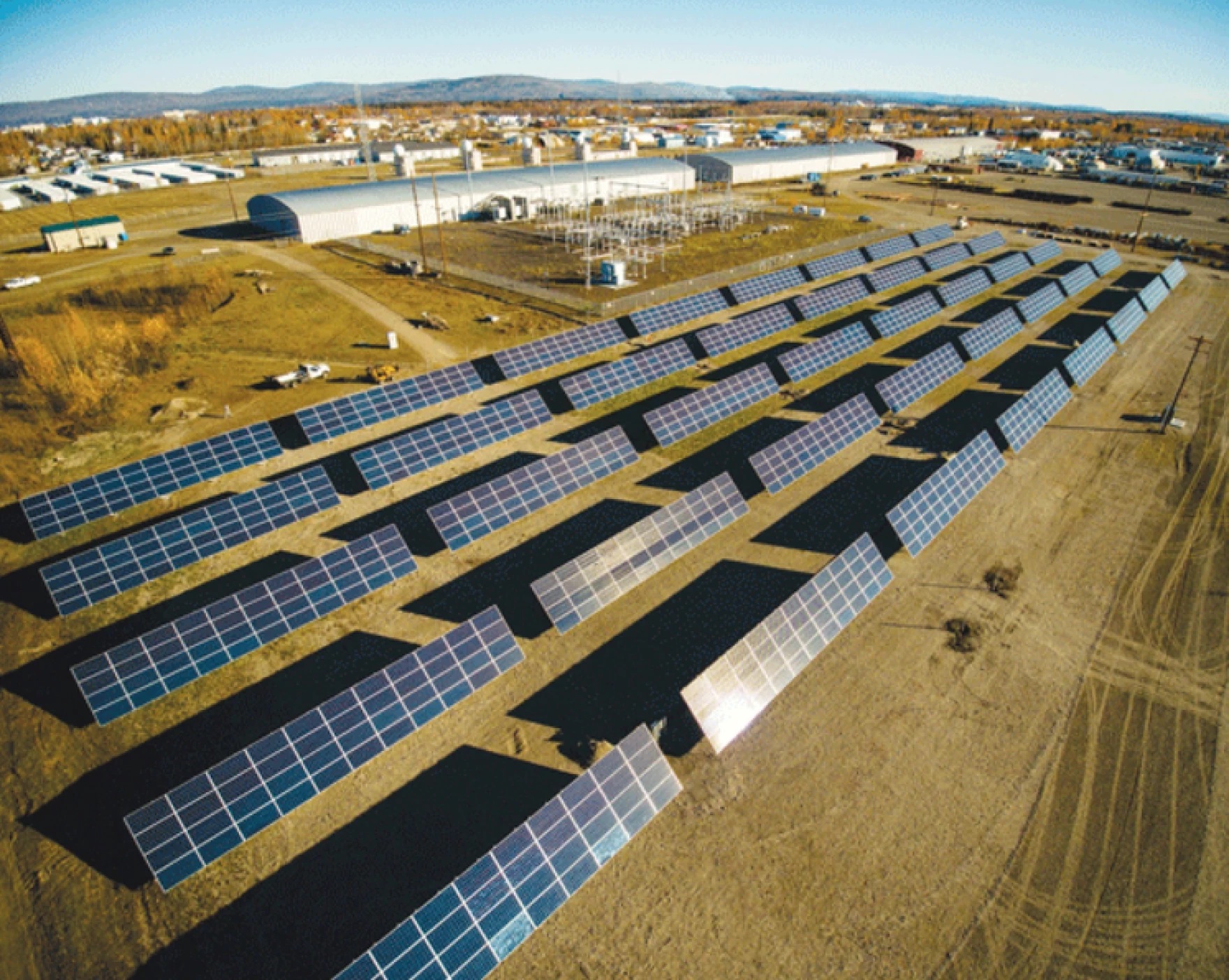
The Golden Valley Electric Association is considering a plan that would allow its members in Interior Alaska to invest in the utility's electric farm and other facilities to lower monthly bills and support the cooperative's efforts to reduce fossil fuel use.
If approved, Golden Valley will begin applying for permits next year for what could be Alaska's first solar project.
For years, Golden Valley has allowed members who install solar or wind energy systems on their homes to lower their monthly bills with credits earned when they generate more electricity than they use. But many members are not able to take advantage of this program.
They may not have a south facing house or a good roof. Or it could be rentals," said Tom DeLong, chairman of the Golden Valley board.
That's why GVEA is considering creating a community solar program that would allow them to avoid the costs of purchasing and maintaining a solar system, DeLong said. Instead, they would buy a solar panel or part of a panel from the Cooperative Solar Farm in Fairbanks. The three-hectare facility in the south of the town generates 563 kilowatts, enough to power around 70 homes.
"The community solar model is trying to provide those benefits to those people who don't want to pay for or invest in a standalone system," he said in an interview Wednesday.
DeLong said many of Golden Valley's members want to help with the cooperative transition from fossil fuels to energy from renewable sources, such as solar power. In response to their interest in community solar energy, the Cooperative Board of Directors provided the GVEA Member Advisory Committee (MAC) with a list of program goals.
"One of them was to make it more affordable for people with low and middle incomes," he said.
A member of the Fairbanks-based conservation organization agrees.
"We welcome the opportunity to increase equity and access to renewable energy," said Kinsley Defler, energy equity coordinator for the Fairbanks Climate Action Coalition. He said his organization strongly supports the community solar proposal.
"It's a viable and affordable source of electricity generation that helps reduce carbon emissions, which helps fossil fuels like coal and natural gas," he concluded in last week's interview. .
DeLong acknowledged that some members of Golden Valley aren't interested in solar power, but said they all benefit from the extra electricity generated by solar power. He noted that community solar subscribers will pay the cost of the program. They can take advantage of the economies of scale offered by GVEA by purchasing several solar panels at once.
"In fact, we hope to oversubscribe and more people will want to participate," he said. And in this case we can realize the biggest project.
DeLong said the initial goal was to get enough subscribers to support a 500-kilowatt solar farm, enough to power about 70 homes. That investment will be paid for by members' savings on their monthly energy bills, according to Fairbanks energy analyst Phil White.
"The average savings for a consumer, if they invest in community solar, is 10 percent," White said in an interview Wednesday. He said the federal Department of Energy has set a goal of increasing those savings to 20% of co-op members' bills by 2025.
White said federal aid for community solar projects should encourage the Golden Valley council to move forward with the program.
"It's an exciting time because the Department of Energy is very focused on this," he said.
If Golden Valley adopts a community solar program, it could be the first in the state. Chugach Electric, Alaska's largest utility, based in Anchorage, proposed a community solar program five years ago, but government regulators rejected it in 2019 as unfeasible. A Chugach spokeswoman said Wednesday the utility is considering the idea.
White said both initiatives are long overdue.
"We've had a solar community in the US since 2007," he said. "What's changed now is that it's almost ubiquitous, and Alaska is behind the curve. We have to catch up."
According to the National Renewable Energy Laboratory, community solar projects existed in 39 states and the District of Columbia as of December 2021. NREL said 22 states, including the District of Columbia, have policies that support community solar.
These policies have helped utilities and nonprofits get community solar projects up and running, said White, who is also an assistant professor of history at the University of Alaska Fairbanks. He is currently working with two Anchorage-based nonprofits, the Alaska Center and the Alaska Public Interest Research Group, to draft legislation that will help advance community solar projects in the state. He said that the measure will be presented in the next legislative session.
DeLong said he expects Golden Valley staff to complete a review of the MAC task force's findings by the middle of next year. If appropriate and the commission moves forward with the program, he said, GVEA will begin submitting rate applications to the Alaska Standards Board in late 2023.

