

PV module prices have finally stabilized and even started to show a slight downward trend. Whether this will continue depends mainly on how demand will develop in the coming months. The low prices reflect a gradual build-up of inventory that will need to be replenished this year if possible, even if it means lower prices. But the situation is very different for other components of a PV system, writes Martin Schachinger of the solar energy wholesaler pvXchange.
For many components of the PV system, there are still no signs of normalization of the supply chain. Manufacturers still have large order backlogs to finalize, so the chaos is likely to continue until early 2023. In addition, several major inverter and energy storage manufacturers have already announced price increases again, the third or fourth time in less time. than 12 months.

One reason for the increase in stocks was the announcement by German politicians of various adjustments to Germany's Renewable Energy Sources Act (Erneurerbare-Energien-Gsetz, or EEG) and federal tax laws. One thing on the minds of investors and developers is the great uncertainty about whether the government will remove the "expected profits" from high electricity market prices. Until there is a definitive answer to the arrival of this potentially retroactive additional tax or potential yield cap, market participants will be cautious. Some believe that returns will be acceptable no matter what, while others prefer to wait and strive for greater planning certainty and outright resistance to market intervention.
The situation is further complicated by the imminent conversion of the EU directive by German lawmakers. The European Commission has approved a reduction in VAT between 0% and 5% for certain goods and services related to photovoltaic installations in EU member states. Germany plans to implement the directive by January 1 as part of an annual tax law. The leader is German finance minister Christian Lindner, who wants a tax break for all photovoltaic systems generating up to 30 kW on single-family homes. and up to 100 kW in apartment buildings that feed photovoltaic energy directly into the public or private grid. Since this capacity is not traded on the electricity exchange, there is no need to calculate the profit. The new law will also reduce the sales tax rate on parts and labor for residential solar PV systems to zero.
insecurity
Again, this program caused uncertainty among installers and reluctance among consumers. Several companies are already complaining about the decrease in orders, at least until the end of the year. At the client's request, installation will be delayed until 2023, and projects already underway will be delayed. In addition, wholesalers still have to pay taxes on purchased components, which means they may have to seek financing to cover the cost of the taxes until they are repaid for their advance in a month or two. Finances are hard to think about, especially in the first two months of the new year. But if we look more closely at the time of the creation of small-scale factories, these problems quickly become apparent.
Even today, small PV projects often take several months to complete, if only because of supply chain disruptions and limited resources between installation personnel, responsible authorities and grid operators. Installers must have financial reserves, have good payment terms with upstream suppliers, or require certain down payments from their customers. Unless the installer and customer agree to fixed performance targets calculated after each phase, the completion date of the entire system determines the tax rate. With the new PV plant coming on line towards the end of the year, completion by January or February is likely to be unrealistic in most cases, so there is no reason for the end customer to delay.
The installer's books can also be full of old orders where at least the inverter and battery have yet to be installed or the AC side has yet to be completed. After the supplier has corrected the problem and started phasing out the ordered items, there should still be enough material and labor available by the end of the year. When the tax break comes into effect next year, the installation of small-scale systems should therefore be more attractive than ever for private homeowners and commercial businesses. For installers, this means preparing for the rush and planning purchases carefully to avoid the hiccups and surprises we've seen this year.
The supply situation remains good, especially for solar panels, and prices are stable. Other ingredients should also be more readily available, as long as epidemics and wars do not create other problems. Installers who have not signed a vendor agreement for 2023 should contact their sales staff. Wholesalers have provided advance forecasts to manufacturers based on this year's experience. Interested end customers who have made a purchasing decision but have not yet placed an order should start. The installation skills of professional installers are and will remain limited, meaning that those who are indecisive simply push back the date they can start using cheap, self-generated, tax-free solar energy to the new year.
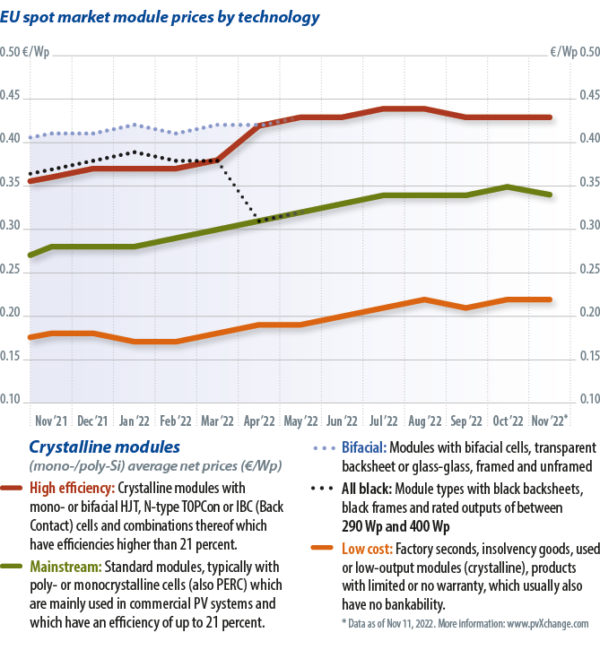
Summary of price range by technology in November, as of November 21, with changes from the previous month;
| Type of glass module | €/Wp | trend since October | trend since January | Information: |
| High efficiency | 0.43 | 0% | +7.5% | 340 Wp+ PERC, HJT, n-type, back contact or combination thereof |
| Conditional | 0.34 | -2.9% | +17.2% | 275-335 Wp, typically 60 cells, standard aluminum frame, white plate |
| Low price | 0.22: | 0% | +29.4% | Factory seconds, expired products, used or defective modules, and limited or non-warranty products |
About the author. Martin Schachinger has a degree in electrical engineering and has been active in the renewable energy and photovoltaic sectors for over 20 years. In 2004, he started his own business and founded the internationally renowned online trading platform pvXchange.com, where wholesalers, installers and service companies can buy solar panels, standard components and inverters that are no longer in production but that are urgently needed. repairing photovoltaic systems. . the damaged one
The views and opinions expressed in this article are those of the authors and do not necessarily reflect those of pv magazine .
This content is copyrighted and may not be reused. If you would like to collaborate with us and reuse some of our content, please contact us at editors@pv-magazine.com.

