

Located in Foster, Rhode Island, the 6.2 MW solar farm provides 3.35 GWh of clean renewable energy annually to more than 700 solar customers.
Rhode Island has ambitious goals for renewable energy generation, including solar power. Many local residents, especially those who benefit most from the cost savings of solar energy, cannot afford to install solar panels on their property for financial reasons or because their homes or businesses are not convenient for them.
This situation is common in many US states. According to the National Renewable Energy Laboratory, US households with an annual income of less than $40,000 – 40% of the US population – own less than 5% of all solar installations. Local solar projects allow many more consumers to benefit from concentrated solar systems, lowering household electricity bills and increasing the share of renewable energy on the grid.
Competition
Solar development and finance firm SunLight General Capital has earmarked a 12-acre rural site in Rhode Island for a 15,800-panel solar array. Arcadia Power Inc. The project, in partnership with a renewable energy provider, meets two criteria: establish Rhode Island's Renewable Energy Growth (REG) program to help the state increase its share of renewable energy and establish a significant community solar initiative. With local solar power, residents can get a 10% discount on their electricity bills, which is a huge benefit in a time of global energy volatility and rising prices.
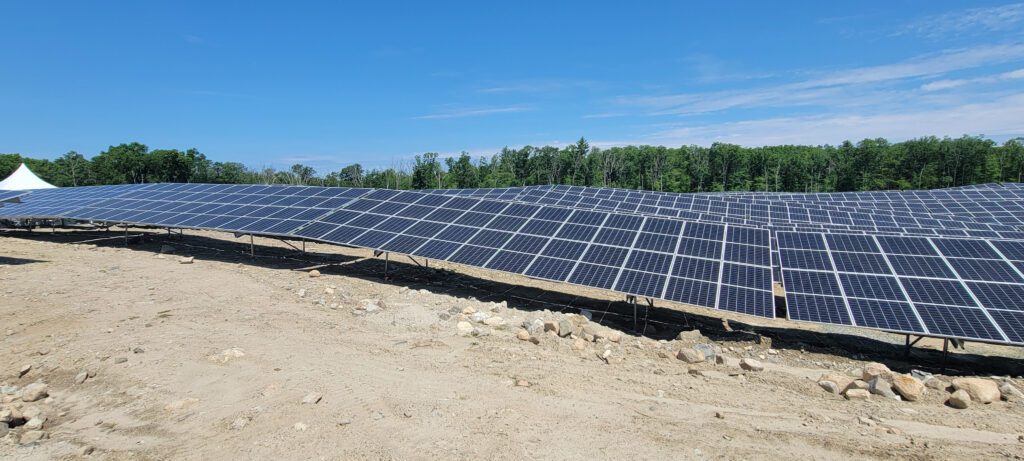
Public solar project sites use land that is unsuitable or undesirable for other uses because of its topography, proximity to industrial sites, or previous uses. The Hartford Pike facility is located on a hill, on uneven terrain, and is surrounded by mature trees (Figure 1). This makes the area unsuitable for a traditional inverter solar system, as panel selection and placement will be limited and tree shading will affect efficiency.

Decision
The economics of community solar initiatives are based on plant operation and ongoing operation and maintenance (O&M) costs. SunLight chose SolarEdge technology for maximum flexibility in module selection and placement, as well as industry-leading monitoring to reduce operation and maintenance costs.
SolarEdge power amplifiers connect directly to one or two modules, allowing them to operate independently of others in the same circuit. This means that if one or two modules fail, for example due to shading, their neighbors will not suffer and maximum power production is guaranteed. In addition, unlike traditional cable systems, the SolarEdge solution can be installed at different angles or directions, on uneven surfaces (Figure 2) or on hills, which increases the number of modules used and the amount of energy produced.
With power optimizers, SolarEdge also offers the ability to monitor system performance at the module level. If a module or pair of modules is seriously damaged, the SunLight team is automatically notified and directed to the exact location of the fault. This allows workers to solve problems quickly and efficiently, reduces maintenance costs and reduces energy waste.
Developer Awareness
“To optimize power generation at the Hartford Pike project, we need to be able to monitor all 15,800 solar panels in real time and identify any issues quickly and efficiently. As the owner/operator of this project, it will be our decision to build it. over the next 25 years,” said James Poches, director of project development at SunLight General Capital. It affects our business.
Between April and September 2021, the Rhode Island project produced 5.81 GWh of solar energy (Figure 3). Of that, 2.46 GWh was allocated to Rhode Island's REG program, and the remaining approximately 3.35 GWh was allocated through the 700 residential and business solar program. Over a year, that translates to at least $74 in savings for each participating home or business, based on current energy prices. However, as grid electricity costs continue to rise, future savings could be greater. In addition, the project has helped reduce air emissions, meaning local residents will enjoy a cleaner environment and lower costs.

The viability of public solar projects depends on the ability of developers to use multiple sites safely and efficiently. SolarEdge technologies are helping to bring the benefits of solar power to a growing segment of the population by installing efficient solar installations in underutilized and underserved areas. By increasing energy production and reducing ongoing O&M costs, investors, installers and utilities are looking to take advantage of the huge opportunities to increase renewable energy production.
- Peter Matthews is the General Manager of North America at SolarEdge Technology.

