
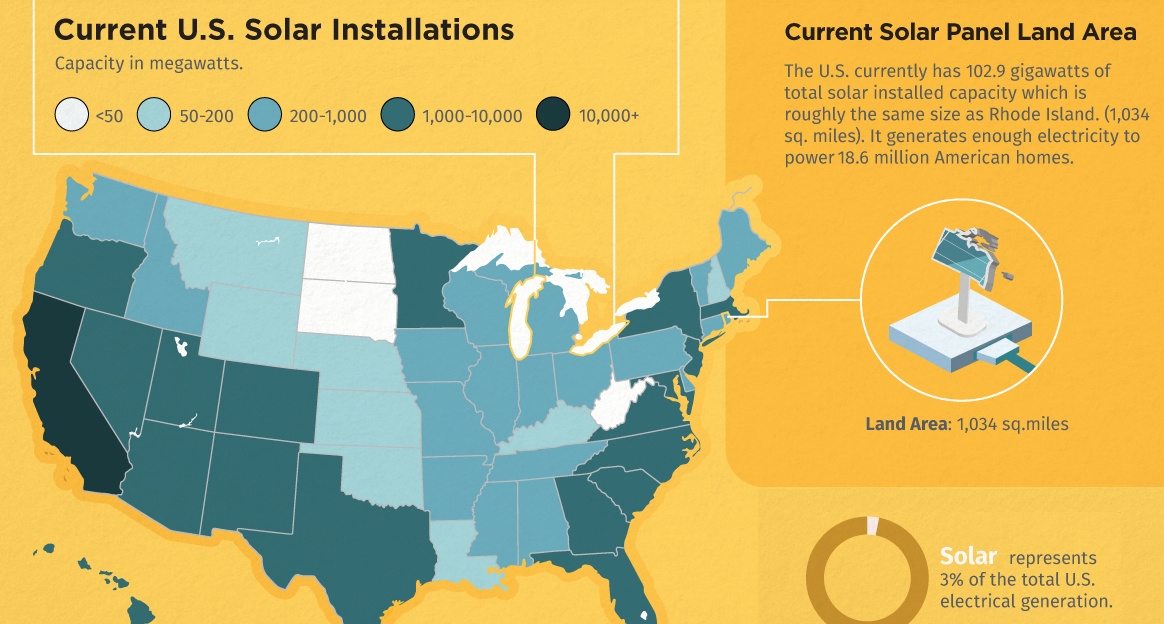
To calculate the best and worst cases for solar power and what solar incentives are available nationwide, we looked at six factors:
- MW of Installed Solar Energy by State
- How many solar jobs are there?
- The number of homes powered by solar energy
- Percentage of energy from solar energy
- Average number of clear days by state
- Average installation cost after federal tax credits
These metrics allow us to assess the solar progress of states, states with strong solar labor markets, and more. From this analysis, it is clear which states are the best and which are the worst for solar energy. However, it should be noted that most states fall somewhere in the middle, suggesting that there is great potential for solar development across the country are.
Best conditions for solar energy
When it comes to sun friendliness, California tops the list. With nearly 150 days of sunshine per year and a strong solar system, job market, and investment in solar, California is an ideal state for solar.
Many other states are seeing a positive trend in using and supporting more solar energy. Arizona, for example, is the country's sunniest state and is approaching one million homes with solar panels.
The worst case scenario for solar power
North Dakota is the worst place for solar power. Although North Dakota's climate is quite favorable for solar energy, the state only has two megawatts of solar power. This is affecting the entire solar labor market and preventing clean solar power from entering the grid.
Solar energy is very underused in many other states that are strong competitors of solar energy. For example, Kansas ranks 44th on the list of the best states for solar energy. However, the Sunflower State enjoys an impressive 128 days of sunshine per year, and the average cost to install solar panels is $ 9,881 , well below the national average. However, of the 110MW of installed solar power, only 0.02% of the state's electricity is supplied by solar panels.
States with the highest and lowest solar development
California currently has the most installed solar MW at 38,145 MW. This energy accounts for 27.3% of the total energy of the state. Nevada and Hawaii have a high percentage of solar power usage.
North Dakota ranks last on the solar power scale with two megawatts of installed solar power, powering 145 homes and 0% of the national average. Close behind are South Dakota and West Virginia, both of which have made no measurable solar contribution to the state's energy supply.
States with a thriving sunny job market
While California is the leading solar market with a total of 75,712 jobs, Florida, Massachusetts, New York and Texas have also created thousands of jobs through solar deployment. These jobs range from chemists and engineers to conductors and power plant operators and everything in between.
This data comes from SEIA and the Bureau of Labor Statistics .
States with the most and least solar powered homes
Once again, California tops the list with 10,510,648 homes currently powered by solar energy, which is not surprising as California is the most populous state. California follows Texas, Florida, North Carolina and Arizona in terms of solar homes.
North Dakota is at the bottom of the list with 149 solar homes. While this is partly due to the state's relatively small overall population, sparsely populated states like Wyoming and Vermont have significantly more solar-powered homes. North Dakota is joined by South Dakota, Alaska, West Virginia and Kentucky.

