
 © Provided by CNET Whether solar panels make sense for your home depends on how much sunlight you get. Andrey Onufrenko/Getty Images
Despite what your TV says, the weather isn't always great in Philadelphia or anywhere else. This means that your solar panels will not always receive sunlight.
Solar panels are quickly gaining popularity as people try to offset rising energy costs and take advantage of new tax incentives. But the financial benefits of switching to solar don't just depend on tax incentives. The amount of sunlight that your solar panels receive plays a large role in the amount of electricity that can be generated by the solar panels.
Therefore, daylight saving time for your environment is an important parameter to understand before going into the sun. Maximum sunshine hours (commonly known as maximum sunshine hours) is a standard measure used to compare the amount of sunlight in different locations.
"With solar, it's important to know peak times and off-peak times," says Rohit Kalyanpur, CEO of Silicon Valley-based solar technology company OptiVolt. "Maximum sunshine hours is not the time between sunrise and sunset, but rather the amount of sunlight at a given location."
Understanding these concepts will help you make good decisions when deciding whether a solar power system will meet your needs. In addition, you can confidently assess the efficiency, cost-effectiveness and environmental impact of any solar system.
Best Solar Companies of 2023 - Check it out on CnetWhat is sun zenith?
The working definition of peak sunlight hours is the one-hour period during which sunlight (solar radiation) generates 1000 watts (equal to 1 kilowatt) of energy per square meter. For example, if your home receives 500 W/m² of solar radiation between 8:00 and 10:00, those two hours are considered peak sunlight hours.
If the location receives 5,000 Wh/m2 (Wh/m²) for 12 hours per day, that 5,000 Wh/m² is five hours of peak sunlight. It is important to remember that 10 hours of sunlight per day does not necessarily mean at most 10 hours per day. The intensity of the sun changes during the day for many reasons, and these changes affect the performance of solar panels.
We can simplify the definition of maximum solar time to the correct equation:
Maximum sun hour (PSH) = solar radiation (kW/m²) × duration (h)
- PSH is the total solar energy received, measured in kilowatt hours per square meter (kWh/m²).
- Solar radiation is the amount of sunlight received at a given location, measured in kilowatts per square meter (kW/m²).
- Elapsed time is measured in hours (s).
In "high sunlight hours" solar radiation is clearly defined as 1 kW/m² and the duration is one hour. The mathematical expression for maximum solar time would therefore be:
- 1 hour peak sunlight (PSH) = solar radiation (1 kW/m²) × duration (1 hour)
- 1 hour of peak sun = 1 kilowatt hour × 1 hour = 1 kWh/m
This means that in the peak times of the sun, one square meter of surface receives 1000 W/h (or 1 kW/h) of solar energy.
How many hours of maximum sunshine does it take to become the sun?
Now that you know all about maximum sunlight hours, how do you calculate the maximum sunlight hours in your area to determine if it's worth investing in a solar system?
How to calculate the maximum hours of sunlight in your area
There are several online tools that can help you calculate your home's peak sunlight hours, including the National Renewable Energy Laboratory's PV Watts Calculator and the European Commission's Photovoltaic Geographic Information System (PVGIS).
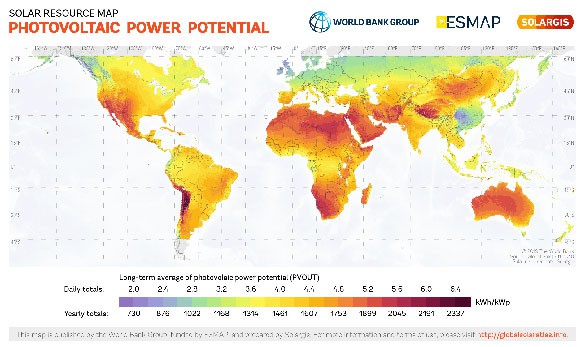
Another tool is the World Bank Group's Global Solar Atlas Portal, which uses another term, Global Horizontal Irradiance (GHI), to describe maximum sunshine hours. The GHI measures the total amount of solar radiation absorbed by a horizontal surface over a period of time. The GI unit is measured in kilowatt hours per square meter (kWh/m²).
"If your home gets an average of four hours of sunlight per day or less, you're a good candidate for a solar system," says Kalyanpour.
This online tool can help you decide if a solar system is a good investment, but there are other things to consider before making a decision:
- The price of electricity in your area
- Solar system size and cost
- Your current energy consumption pattern
Does my state get enough sun for sunbathing?
Maximum daylight hours vary from state to state. For example, Nevada enjoys 4.6 to 5.8 hours of maximum sunshine, making it one of the best places in the solar system in the United States. Washington, DC, by contrast, gets between 2.8 and 4.4 hours of peak sunlight, making it one of the worst places in the solar system in the United States. Although Washington receives less sunlight, having a solar system can still be beneficial.
Other factors to consider include incentives, tax credits and rebates available to residents who invest in solar energy systems.
Here is a table of average daily maximum sunshine hours by state according to the Global Solar Atlas Portal:

