
Energy Vault NRGV, co-founded by Idealab's Bill Gross, reported strong quarterly earnings in April after its first three months as a public company.
I had the opportunity to speak with Robert Baconi, co-founder and CEO of Energy Vault, and I was impressed with his experience building a multi-faceted company.
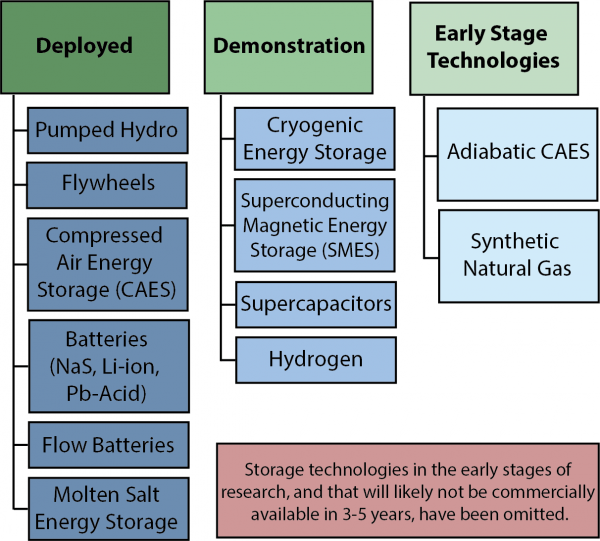
The next article will detail what Energy Vault does, but first I wanted to provide some insight into energy storage technology in general to provide context for my comments about Energy Vault.
This paper examines two modes of grid-scale energy storage (pre- and post-generation), discusses some of the challenges associated with these two methods, and the technologies used to implement them, and provides an overview. Calculate the size of the problem we need to solve.
If you need information about this article, check out my previous articles on this topic:
Fasten your seat belts! Storage is an interesting topic, and at the network level it's more complicated than just plugging your iPhone into a wall outlet.
Storage before and after delivery Storage before deliveryStorage before production provides a form of fuel that can be converted into electricity so that we can do some work.
Coal reserves in this sense are a form of pre-storage, just like uranium reserves for a nuclear power plant or river water storage behind a dam. The storage of potential energy - in chemical or nuclear bonds, or by gravity and location in the case of dams - is an old way of doing things.
While the old-fashioned storage devices of the previous generation solve many problems for organizations tasked with providing us all with electricity when we need it. Demand for electricity varies with time of day, season and weather severity. Having fuel reserves allows operators to quickly produce electricity for the grid during sudden spikes in demand.
Storage after deliveryIt's a form of storage that most people would probably think of intuitively because that's what most people do every day: plug their phone or other mobile device into an outlet to store electricity in the device's lithium-ion battery.
Storage after energy generation has become an especially important topic with the growing popularity of solar and wind energy generation. Solar and wind farms sometimes produce more electricity than the grid needs. If we can store this excess electricity as readily available potential energy that can be used when electricity demand is high, the carbon footprint of our grid will be significantly reduced.
We have a storage problemIn a previous article on grid upgrades, I wrote that grids were never designed for energy storage. I have since realized that grids have actually always been designed to store energy, just in one form even before it was created.
The inspiration came from reading Meredith Angwin's book Shutting Down the Grid: The Hidden Vulnerabilities of Our Electric Grid. In this book, he shows that the shift from coal to natural gas has disrupted both real and negative storage dynamics*.
Unlike coal-fired or nuclear power plants, which store fuel for months, natural gas-fired power plants do not store fuel in storage. Natural gas flows directly from pipelines to a generating plant, which in the world of manufacturing might be called just-in-time inventory management.
This timely management of natural gas means that energy storage capacity before power generation is reduced compared to the switch from coal to natural gas as a fuel for power generation. Shortages of natural gas supply led to blackouts in Texas during the cold winter of 2021 and last winter in the Northeast.
We also have problems with storage after generation.
Usually, when people think of energy storage after generation, they think of electrochemical batteries. However, batteries currently make up a small minority of electrical capacity.
About 90% of the current energy reserves of the network are in the form of pumping stations. This type of storage uses energy to pump water from a lower reservoir to a reservoir several hundred feet higher during times when electricity demand is low. Then, as demand increases, water is released from the upper reservoir to run generators to produce the required electricity.
Although this solution works well, it has some problems. From an ecological point of view, several thousand tons of reinforced concrete must be used in the construction of these structures, which increases carbon dioxide emissions. Additionally, these structures tend to be located in scenic locations (hills, rivers, and lakes are important inputs), so there is often strong resistance to building an industrial structure over a lake versus someone's attractive cottage. Finally, there are clear topographic and geographic boundaries; You can't easily build one of these factories in a place where there are no hills, rivers or lakes. Because of these shortcomings, not a single new hydroelectric plant has been built in the United States for nearly 30 years.
Electrochemical batteries are the obvious "real" solution that should stick in the minds of many people simply because they're familiar, but batteries currently make up only a very small fraction of the power on the American grid.
As I mentioned in previous articles, there are also problems with batteries. Lithium-ion cells - the leading battery technology at the moment - may be great for cell phones, but it's not clear to me that this technology is a great network storage technology. Challenges include scarcity of raw materials, relatively short lifespans, fire hazards and toxic chemical releases, and sensitivity to extremes of temperature and cold.
One of the reasons I'm so interested in EnerVenue, a company I wrote about in late 2020 and will write more about soon, is that their metal hydrogen batteries make up for many of the shortcomings of lithium-ion batteries. ion technology.
Another next-generation energy storage technology I've talked about in this column is compressed air energy storage (CAES). CAES is an ancient technology that first appeared in the 1970s and 1980s and has recently experienced a renaissance. The main problems with CAES are efficiency (most CAES systems recover only 50% of the energy initially generated, the rest being wasted as heat and other factors) and site selection issues.
Last year I mentioned the Hydrostor in this column (see link in the introduction), which I found to be a very smart way to improve the efficiency of the CAES process.
Memory scaleThe largest battery manufacturer in the United States is Vistra Moss Landing in Monterey County, California, which can run 400 megawatts (MW) for four hours. In the power sector, this means it has a capacity of 1,600 megawatt-hours (MWh).
According to the California Energy Commission, the state produced or imported about 300,000 megawatt-hours of fossil fuel-based electricity per day in 2020. Additionally, in 2020, California produced about 250,000 megawatt-hours of electricity per day from renewable sources.
Based on naive calculations based on these statistics, to completely phase out fossil fuel production, California would need to roughly double the amount of renewable generation capacity installed and built around them. 350 times, the same larger capacity that exists today.
Keep in mind that these calculations were made by someone with a background in electrical engineering, based on research from Wikipedia articles. Also keep in mind that I am not suggesting other changes to the energy mix (such as nuclear power), nor am I suggesting abandoning the current centralized model of energy production and storage in favor of a local distributed model discussed in the previous article, not discussed.
While a more experienced person may quibble with the details above, these calculations should provide at least a rough estimate of the strength and size of storage requirements.
Using this storage overview as a reference, the next article will look at Energy Vault's post-generation data storage solution. In short, the Energy Vault solution creatively overcomes some of the major drawbacks of today's data storage technologies.
Smart investors, take note!
Notes:
* Natural gas is probably a much cleaner fuel than coal, so reducing storage capacity also costs less in greenhouse gas emissions. However, in recent years it has become clear that the potential climate benefits of natural gas are largely offset by methane leakage from the supply chain, itself a potent greenhouse gas. See "The Cost of Reducing Natural Methane Emissions" by L. Marks, published in the Journal of the Society for Environmental Protection and Economic Resources, and Bloomberg's article on systematically reducing methane losses.

