

Fertile land is an unconditional gift. Since the last ice age, humans have cleared one third of the forests and two thirds of the wild prairie, most of which is used for agriculture . And as the world's population continues to grow — 8 billion last November — farmland is under increasing pressure not only to produce more food, but also to generate clean energy.
In places like Yakima, Washington, this has created competition for space as earth-hungry solar panels gobble up available space. Last month, the State Public Utilities Assessment Board approved plans to cover 1,700 hectares of farmland with photovoltaic (PV) panels, calling into question the shutdown of solar projects in the region and raising public concern about their long-term impact. Farmland.
However, a new study from the University of California, Davis shows how farmers will soon be able to harvest crops and energy at the same time. The researchers concluded that visible light spectrum bands could be filtered and used separately (blue light wavelengths for solar power generation and red light wavelengths for growing vegetables and fruits) for use in agricultural land, while reducing heat stress and reducing crop losses.
"Why should [farming] be a zero-sum game when we can improve the land for both?" asks Majdi Abu Najm, a professor in the Department of Land, Atmospheric, and Water Resources at the University of California, Davis and fellow at the Environment Institute , who is one of the paper's authors.
He explains that the photons, or particles that make up light, have different properties: blue photons have higher energy than red photons, and they emit light at a shorter wavelength and higher frequency. While this blue light provides the boost needed to generate power, the extra ripple also causes the temperature to rise.
“From a botanical point of view, red photons are efficient,” says Abu Najm. "They don't overheat the plants."
Using computer simulations, Abu Najm and lead author Matteo Camparis, professor of civil, environmental and architectural engineering at the University of Padua, found that exposing plants to red light waves increases photosynthesis and carbon uptake, the process by which carbon dioxide is converted into organic matter. matter. Compounds that reduce perspiration. In other words, in the cooler range, "plants can get the same amount of carbon dioxide using less water," he says.
While their research is inspired by hydroponic lighting used in indoor growing systems, "energy costs are high," says Abu Najm. "We decided to use sunlight as an input."
According to Abu Negma, one of the main goals of the study is "to motivate the industry to create next-generation solar panels." Camporese saw potential in organic solar cells , which, unlike silicon-based shiny metal surfaces, are made up of carbon compounds. A thin transparent cell is applied in the form of a film on various surfaces, including glass. He said the technology could be used to develop selective photovoltaic panels that filter blue light for energy and pass the red spectrum to plants growing directly below it.
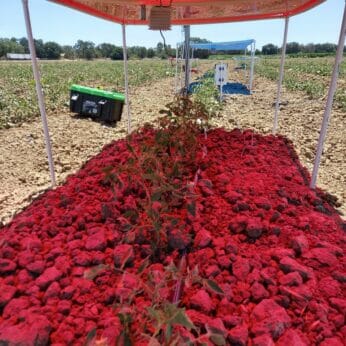
Tomatoes are grown under solar panels that filter light. Image courtesy of UC Davis.
The advent of photovoltaic agricultural fields, where land is used for food and energy production, has made land use more efficient by placing conventional solar arrays between rows of crops. (Sunny grazing is a type where animals graze between rows.) Corner panels protect heat-sensitive greens and fruits from the scorching afternoon sun; At the same time, the plant removes moisture and reduces the temperature under thermosensitive cells, thereby increasing their efficiency.
However, cell culture cultures are grown in partial shade, and "less light usually means lower yields," Camparis says. This effectively limits the density of solar panels and plants in CHP plants. But a transparent array would allow full coverage of both fields, he notes, increasing land use and delivering a significant increase in productivity per acre.
In May of this year, researchers conducted a limited field study of photosynthetic plants at the UC Davis Agricultural Experiment Station. The team planted treated tomatoes, a common crop in the Sacramento Valley, in small patches of uniform size, one covered with a red photoselective filter, another with blue, and a third exposed as a control.
After about four months, including a record heat wave in early September, the shielded plots produced about a third less than the open plots. However, when sorted by quality—ripe, unripe, or “bad”—there were twice as many rotten tomatoes as in the control plots. “Thus, filters help reduce heat stress,” says Abu Najm, “and reduce [harvest] waste by more than half.”
He added that the increase in electricity generation and net profit more than compensated for the decline in production. In co-location of factories and solar power plants, "100 percent is very little when you can get 120 or 140 percent of the crop."
And for countries and regions facing acute shortages of agricultural land, the productivity gains are even more valuable, especially when you consider that clean energy production requires 10 times more land per unit of energy than fossil fuel production.
Abu Najm also sees the canopy approach as a way to increase farmers' resilience to climate change. Solar filtration helps the soil retain moisture and protects farm workers from harsh rays, while less evaporation means plants need less water. He added that by generating their own energy, farmers can offset higher electricity costs and encourage industry to adopt electric equipment and vehicles.
“By 2050, we will have the [last] 2 billion people on the planet and we will need 60% more food, 40% more water and 50% more energy,” Abu Najm said. To meet this growing need, research must take place at transformational levels.
He added that by maximizing the solar spectrum, "we are infinitely improving sustainable resources." “When technologies are used that can expand these panels, the enhanced capabilities are beyond our remit.”

