

Solar power from space can provide 24/7 access to renewable energy and circumvent one of the biggest limitations of technology. The concept is nearing its first real test to gauge its feasibility after successfully launching experimental hardware from the Falcon 9 rocket .
The idea of putting giant solar panels into orbit around the Earth and bringing back energy has been around for decades. The perspective is attractive because in space you are no longer dependent on the weather or the day and night cycles of the planet, and the solar irradiance is higher because sunlight does not have to pass through the atmosphere.
However, due to the technical complexity and relentless economics of space technology , space solar energy has so far remained a science-intensive field . But thanks to a $100 million grant in 2013, Caltech's multidisciplinary team has been working quietly over the past decade to develop the various technologies needed to make it a reality . And last Tuesday , prototypes of some of the key subsystems needed for a large solar power plant in space were put into orbit by SpaceX for testing.
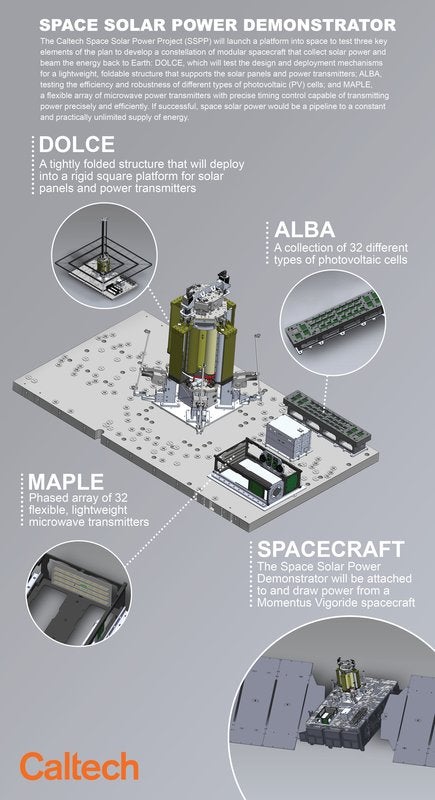
Over the next few months , a team led by the Caltech Space Solar Power Project will test systems that will allow them to deploy flexible solar arrays in space and technologies to transfer power to Earth . They will also assess how well different types of solar cell technologies withstand the rigors of space .
"Whatever happens, this prototype is a big step forward," Ali Hajimere, one of three Caltech professors leading the project, said in a statement . “He is working here on Earth and has gone through the rigorous steps required for launching into space. There are still many risks, but the whole process has taught us valuable lessons.
Building solar systems in space is a much more difficult task than on Earth. The biggest challenge is reaching them in the first place, limited by the prohibitive cost of launching hardware into orbit. As a result, the team had to focus on keeping the weight of the solar panels as light as possible without impacting their production capacity.
Their solution combines ultra-thin flexible solar panels, an innovative design that integrates power generation and transmission, and a new modular architecture that allows large arrays to be assembled from many small stand-alone modules.
The basic element of their design is a rectangular tile a few centimeters wide with a mirrored solar concentrator on the roof that converts sunlight into a strip of photovoltaic cells where it is converted into electricity. Beneath the roof is an integrated circuit that converts energy from the solar panels into microwaves, which are then transmitted to the underside of the tiles via a series of ultra-thin and flexible foil antennas.
This design significantly reduces weight because it does not require thick cables to transfer the generated energy to the central transmitter. These tiles are then arranged in strips and assembled into a new folded structure that collapses on launch and then unfolds in space.
The result will be an autonomous spacecraft capable of turning around, generating energy and returning it to Earth, but the vision is to combine many of them into arrays capable of generating amounts of energy comparable to Earth. Procedure. This setting simplifies array sizing and configuration and means that the loss of individual blocks does not cause the entire system to fail.
The tests launched this week are designed to test some of the core technologies behind this architecture. DOLCE (Light Deployable Vehicle in Experimental Orbit) will test the opening mechanism by deploying a six-by-six-foot tire from a small container the size of a garbage can .
Another, called MAPLE (Microwave Array for Low Orbit Energy Transfer Experiment), will test an array of lightweight microwave transmitters designed to transmit energy long distances in space. The final experiment, called ALBA, will test 32 different types of photovoltaic cells over several months to see which perform best in the harsh environment of space.
Assuming all testing goes as planned, the researchers will test some of the key technologies needed to bring their vision to life. But with the falling cost of solar power on Earth and the growing adoption of energy storage technologies to deal with solar outages, the concept raises questions about its cost-effectiveness and practicality.
However, technology can play an important role over time, writes Ars Technica's Jon Timmer . Most estimates suggest we could transition around 70% of our grid to renewables quite easily, but unreliability due to seasonal changes or erratic weather means the transition could be difficult.
Renewable energy, available 24/7 , can help fill this gap when ground conditions affect energy production. We may need decades more, but given the complexity of space solar power, working on this technology now seems like a reasonable bet.
Photo credit: Caltech.

