

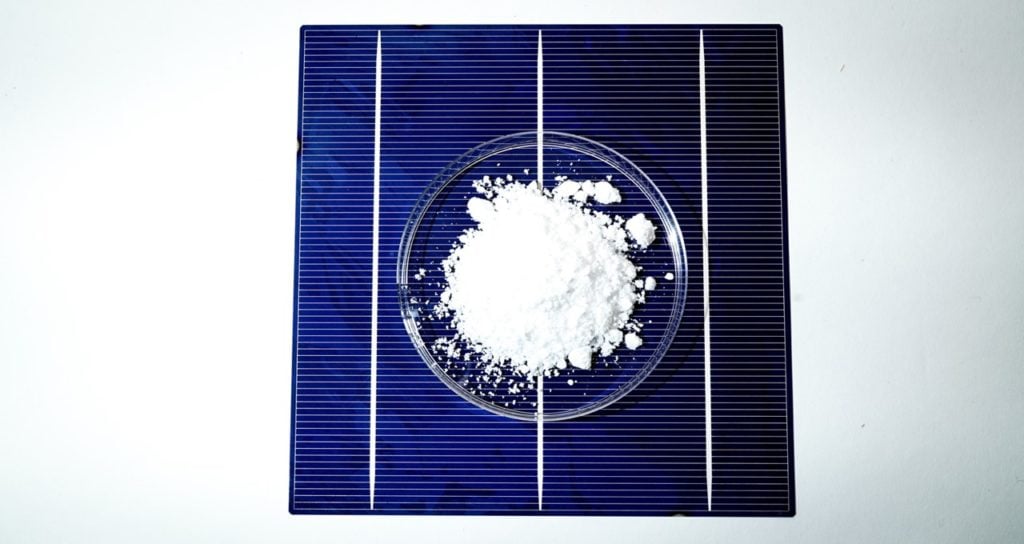
While Europe is struggling to build a domestic solar industry, the Swedish startup's algae factory is designed to improve the efficiency of solar panels that require only one application and are built in a sustainable environment.
“Basically we are trying to do circular production with neighboring businesses,” says Simon Nilsson, technical lead solar producer at the Swedish algae plant. .
The company uses three different properties of algae to improve the efficiency of silicon solar cells, one of which is a diatomaceous earth shell, which Nilsson says is "excellent" in capturing and transmitting light, thus acting as an anti-reflective coating. Increase efficiency by at least 4%.
Another function is thought to extend the life of the solar panel by blocking ultraviolet light, Nilsson said, adding that the solar panel is converted into electricity.
“What we think about silicon solar cells and other elements is how to create a coating on a solar panel. An outer layer of glass or solar polymer is placed on top of the solar panel.
These properties have been independently verified by the Swedish Rice Research Institute.
Meanwhile, Swedish company Algefabriek will combine its unique material called Algica with dye-sensitized solar cells (DSSC) in an active solar panel to increase the possibility of creating a longer light path through the solar panel. . Electricity. In this process, the company was able to measure DSSC performance at 36 percent in a research project with Chalmers Technological University.
According to Nielsen, a big challenge in the future is the durability of the coating in the field: “under direct exposure to normal weather conditions, it should last for a very long time, about 30 years.”
While coverage is not yet commercially viable, both residential and terrestrial applications are prime targets for applications, as floating solar array makes its weatherproof applications practical.
Nilsson stressed the importance of working closely with other companies not only in Sweden but also in Europe, because being in the same time zone and traveling across the continent makes things easier.
Nielsen's current priority is to use coatings on newly installed solar panels because it will be a "more controlled environment" and will immediately improve efficiency by 4%, the company is considering upgrading. .

